Page History
...
Encoding/decoding TMC location references versus OpenLR location references
Below table explains the differences between encoding/decoding TMC location references versus OpenLR location references.
| encoding | decoding | |
|---|---|---|
| TMC |
Encoding TMC location codes (also known as Problem Locations or PLOCs) are defined in a TMC location references ... |
Decoding TMC location references ... |
| OpenLR |
Encoding OpenLR location references ... NB for simplicity only two LRPs are shown. Actual OpenLR location references could contain additionally |
Decoding OpenLR location references ... |
...
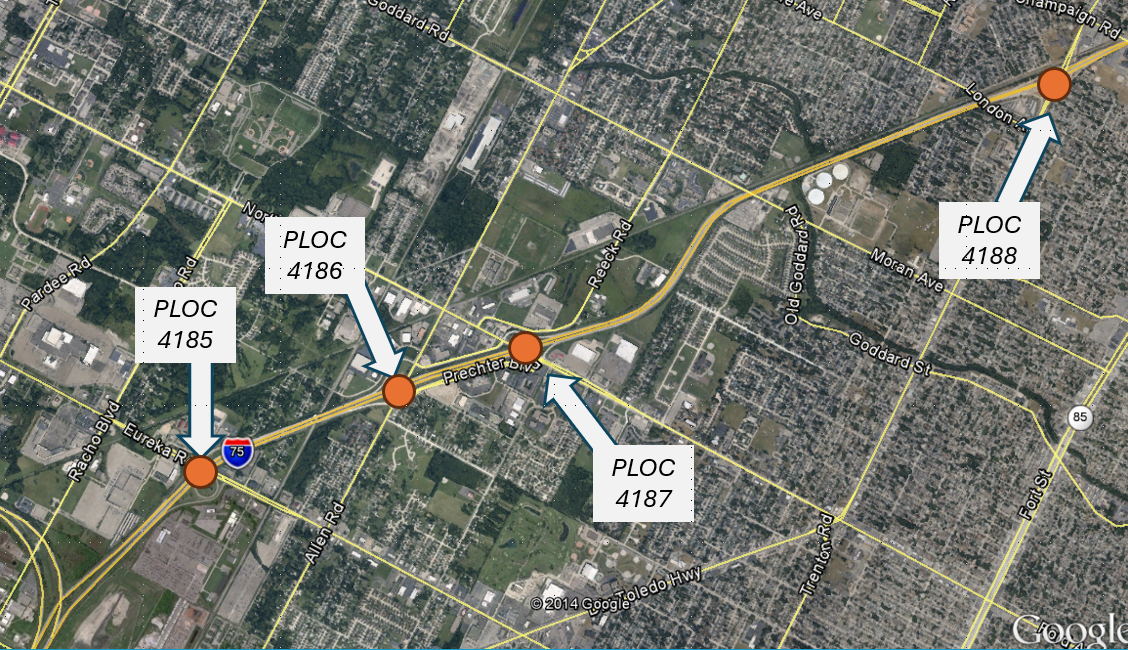
table. Point Locations are most commonly used for TMC location referencing. A point location typically refers to an intersection in e.g. along a Highway. In a TMC location table, a TMC point location has as attributes
Thus based on the WGS84 coordinate pairs, these TMC problem locations can be overlaid on a satellite image (as above) or overlaid on a scanned map for defining TMC location references. No digital map with routable roadsegments is needed! Encoding TMC location references entails first identifying which TMC location codes straddle the location of the event of interest. In the picture above assume these are PLOC 4185 and PLOC 4188. PLOC 4188 is referred to as the Head Location (the location point where a driver exits the event), and PLOC 4185 as the Tail Location (the location point after which a driver would enter the event) Given this information and the previous/next links in the TMC location table then a TMC location reference is constructed as:
|
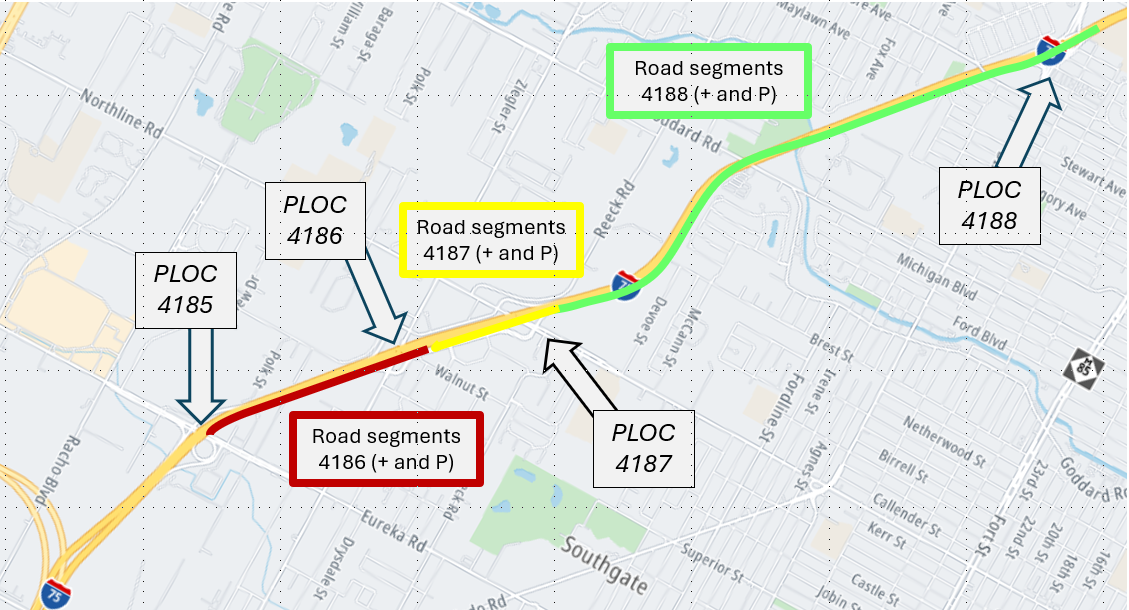
Decoding TMC location references in a receiver first involves expanding the Head Location (4188) and Extent (-3) again into the set of TMC locations, i.e. 4185, 4186, 4187, 4188, using the TMC location table and the previous linkage. Given this set of locations and the driving direction (positive, or using the next linkage), then in a digital roadmap, the set of relevant road segments can be retrieved. In TMC enabled digital maps, individual road segments have an attribute indicating to which TMC point location they are leading to, and whether that is external to the TMC problem location or internal, e.g. in case of a large highway intersection with separate exit and entry link roads. For the positive driving direction these segments are labeled as '+' for external segments and 'P' for internal segments. Thus for the given location reference, this involves identifying road segments with attributes
Stringing together these road segments provides then for the location of interest in the receiver. | |
| OpenLR |
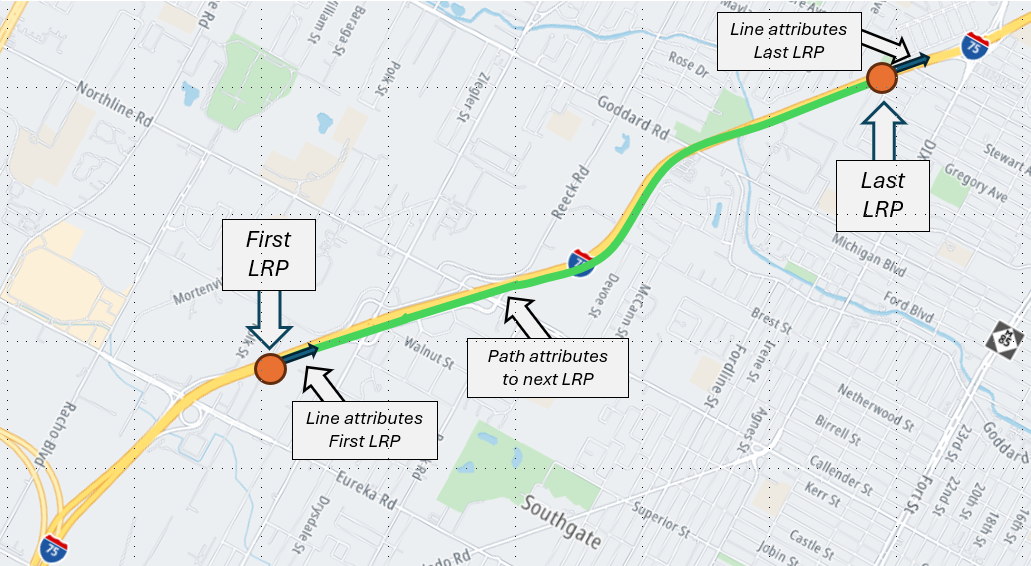
Encoding OpenLR location references relies directly on a digital road map and its routable road segments. To create an OpenLR location reference, a digital map with routable road segments is therefore required. The intended location reference represents a routable path. This path is described by selecting at least two Location Referencing Points (LRPs), which together define the location. Each LRP has the following attributes:
In addition, for the path between two successive LRPs, the following attributes are defined:
Note: For simplicity, only two LRPs are shown here. In practice, an OpenLR location reference may include multiple intermediate LRPs to ensure that each routing path between successive LRPs is unique. |
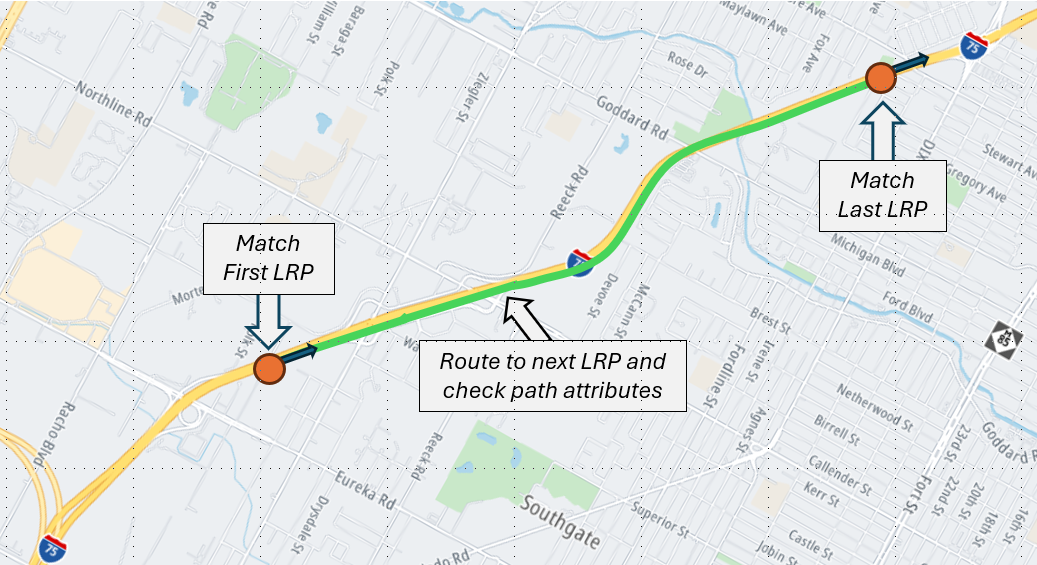
Decoding an OpenLR location reference also relies on a digital road map with routable road segments. A digital map that supports routing is therefore required to decode an OpenLR location reference. The decoding process starts by matching the Location Referencing Points (LRPs) onto the receiver’s digital map. This matching is based on the WGS‑84 coordinate pairs in combination with the associated line attributes. These line attributes help identify the correct road segment and travel direction. The Bearing attribute is used to determine the direction of travel at the LRP. In situations where multiple nearby or parallel road segments exist, the FRC and FoW attributes help distinguish between roads of different importance and type, enabling selection of the most appropriate candidate. In a second step, the route between successive LRPs is reconstructed using a routing algorithm on the receiver’s map. The validity of this reconstructed route (and thus of the decoded location reference) is verified using the provided path attributes. These attributes indicate the expected length of the route (DNP attribute) and whether the route remains on roads with the expected functional road classes (LFRCNP attribure), rather than diverging onto lower‑importance roads. Together, the line attributes and path attributes provide a highly robust decoding mechanism. This robustness makes OpenLR highly interoperable across digital maps from different vendors and across different map vintages, for example, when decoding is performed on an older map than the one used during encoding. |
In summary, TMC and OpenLR represent two fundamentally different approaches to location referencing. TMC is table‑driven and map‑agnostic at encoding time, relying on predefined point locations and logical linkages rather than on a routable digital maps. Decoding TMC references requires TMC‑enabled maps that explicitly link road segments to TMC locations. OpenLR, by contrast, is fully map‑based: both encoding and decoding depend on routable digital maps, with location references defined as paths between Location Referencing Points enriched with line and path attributes. These attributes enable robust matching and route reconstruction, making OpenLR highly resilient to map differences across vendors and vintages. As a result, OpenLR offers greater flexibility, scalability, and interoperability for modern digital map ecosystems, while TMC reflects an earlier, compact, but more static approach to traffic location referencing.
Migrating from TMC to OpenLR: impact on Location Referencing Workflows
Migrating from TMC to OpenLR (has a direct impact on how locations are defined, encoded, transmitted, and decoded throughout the traffic information workflow. While TMC is based on pre‑coded, table‑driven location references with relatively simple encoding and decoding logic, OpenLR introduces a fully map‑based, dynamic approach that relies on routable digital maps and algorithmic matching. The table below compares the key workflow steps for TMC and OpenLR, highlighting how responsibilities, dependencies, and computational complexity shift when moving from a static to a dynamic location referencing paradigm.
Workflow Step | TMC (Traffic Message Channel) | OpenLR (Dynamic Location Referencing) | Key Differences / Notes |
|---|---|---|---|
1. Location Model | Pre-coded locations stored in a Location Table with static IDs | Dynamic encoding based on geometry, topology, and attributes | OpenLR does not rely on static tables; supports unlimited locations |
2. Map Dependency | Relatively dependent on the specific map version/revision used to build and link the TMC table codes to the road network map elements | Map‑agnostic and designed to work across multiple maps and versions | As road networks evolve, older TMC location tables may become outdated. With OpenLR, a larger difference between source and target map versions needs careful matching to ensure correct location referencing, it may reduce success rate . |
3. Location Identification | Lookup of a pre-defined TMC Location Code based on table or attributed map elements. | On‑the‑fly encoding of point/line based on actual map geometry | TMC is instant lookup; OpenLR requires computation |
4. Encoding Process | Encoding = selecting the right TMC Location Codes from the table | Encoding = generating a reference path via attributes + geometry | OpenLR encoding is computationally heavier but flexible |
5. Message Construction | Very compact messages (a few bytes) | Larger messages (~20–30 bytes for a line location) | Size is rarely an issue today, but OpenLR uses more bandwidth |
6. Transmission | Typically used in broadcast (RDS, DAB), and low‑bandwidth IP environments | Typically used in wider bandwidth IP-based environments. | OpenLR is suitable for richer digital ecosystems |
7. Decoding Method | Match Location Codes to same TMC table on receiver side, and look up associated map elements in map. | Decoder reconstructs location using map matching + shortest-path algorithms | OpenLR decoding is more CPU-intensive compared to TMC decoding |
...
